


Firelight Media Announces 2026 Recipients for the William Greaves Research & Development Fund


International research and development fund grants to mid-career filmmakers with unrestricted financial support
Firelight Media, a nonprofit organization that supports, resources, and advocates on behalf of nonfiction filmmakers and storytellers of color, is pleased to announce the 11 recipients of the 2026 William Greaves Research & Development Fund. The Greaves R&D Fund was established in 2020 to support documentary filmmakers of color, with a specific focus on artists of Indigenous and/or African descent. For this cycle, Firelight Media awarded up to $20,000 USD per project and expanded to include multimedia projects.
This year, eligibility for the Greaves R&D Fund was extended to filmmakers from across North, Central, and South America, as well as the Caribbean, through a nomination process with local partner organizations* across these regions. Recipients were selected through a review process that included a dedicated advisory board, which will also serve as mentors for the filmmakers throughout the year-long grant cycle. The 2026 advisory board includes Firelight Media’s own Chloë Walters Wallace, Director of Regional Initiatives; filmmaker and previous Greaves R&D Fund recipient David Hernández Palmar; curator and programmer Heitor Augusto; Maya Austin, cultural strategist and grantmaker; and artist and social movement strategist Aisha Shillingford.
2026 recipients include filmmakers from Brazil, Mexico, Colombia, Guatemala, Panama, Guadeloupe, the United States, and Canada. Their film projects include a diverse array of genres and styles, including historical documentaries, surrealist fables, visual essays, and travelogues. Their subjects include Black and Indigenous liberation, intergenerational healing, family legacies, and gender justice.
"Firelight Media is proud to have expanded eligibility for the William Greaves Research & Development Fund to all of Abya Yala [an Indigenous term for all of the Americas] this year,” said Loira Limbal, President & CEO of Firelight Media. “Across this vast region of the globe, there is so much shared history of liberation across territories, tribes, genders, and generations. We’re honored to provide unrestricted funding to this remarkable array of nonfiction projects, and we’re excited to track their progress over the next few months and years.”
The William Greaves Research & Development Fund addresses the persistent structural challenges many filmmakers face after producing their first nonfiction films and audiovisual projects, enabling them to remain in the field and continue to create vital stories focused on underrepresented people and topics.
The selected filmmakers and artists will use these funds for research and to develop film treatments, decks, sizzle reels, and other materials necessary for fundraising and creative development.
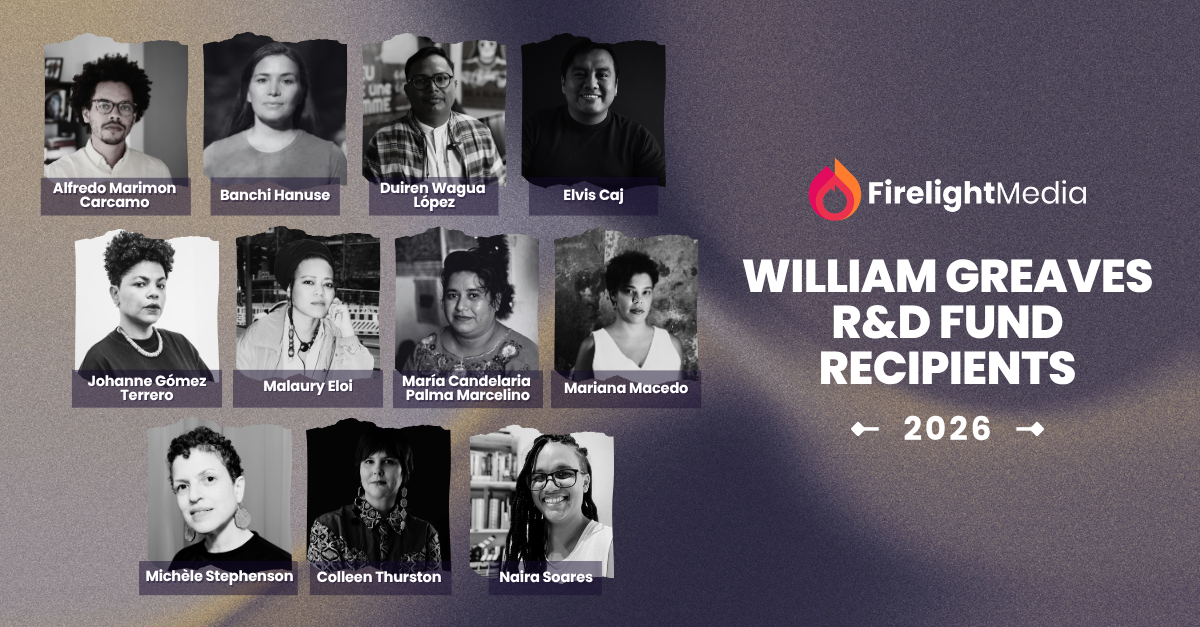
The 2026 William Greaves Research & Development Fund recipients are:
- Alfredo Marimon Carcamo [he/him], Agua de la Virgen (Colombia)
A young man from Cartagena, raised near the Ciénaga de la Virgen lagoon, seeks to improve his life by building a fishpond. In the process, he confronts inequality, environmental problems, and discrimination, discovering a city that marginalizes its outskirts and transforming his relationship with it. - Banchi Hanuse [she/her], Untitled (Canada)
An intimate documentary exploring legacy and the enduring call of the road through the life of a remarkable performer. - Colleen Thurston [she/her], Untitled Freedmen Film (United States)
Untitled Freedmen Film uncovers the history of the formerly enslaved people of the Choctaw Nation of Oklahoma. - Duiren Wagua López [he/him], Bannaba [Beyond] (Panama)
A tribute to someone who knew how to listen to their territory and turn it into music. - Elvis Caj [he/him], Volveremos (Guatemala)
Volveremos follows young Indigenous people as they navigate migration, discrimination, and the loss of cultural ties. Between precarious urban lives and opportunities abroad, they reshape their language, appearance, and identity to belong. Through intimate testimonies, the film questions the romantic idea of return: leaving changes not only the place, but also those who leave. - Johanne Gómez Terrero [she/her], Venus en dos actos (Dominican Republic)
Two trans women writers sail across the Caribbean on a yacht, heading toward Colombia; Mikaelah is going to have breast augmentation surgery. Her friend Johan is accompanying her to take care of her during her postoperative care and recovery. They abandon the conventions of transition to embrace gender cimarronage. - Malaury Eloi, Sleepless Land (Guadeloupe)
In Guadeloupe, a filmmaker works from within a territory shaped by colonial history that never fully ended. She moves through contaminated lands, political tensions, and fragmented memories, where buried stories keep resurfacing. In her journey, reality appears unstable, held together by both struggle and haunting, where the dead remain part of the present landscape. - María Candelaria Palma Marcelino [she/her], El arreglo (México)
El arreglo portrays the lives of girls, adolescents, and women from the communal lands of Cacahuatepec, Guerrero, who enter adulthood at a very young age. Through their voices and their daily lives, the documentary explores how traditions, early motherhood, and gender roles shape their lives. - Mariana Macedo [she/her], O coração é um vórtice orientado [The heart is a directed vortex] (Brazil)
Following the course of a river as a metaphor for Black existence in Brazil, this essay-documentary intertwines letters from a Black woman to her partner, mapping the fears and desires of those who struggle to exist and belong in a country that straightens rivers, bodies, and destinies, yet never contains their waters. - Michèle Stephenson [she/her], Oshun and My Grandmother: A Fable in 4 Movements (United States)
Oshun and My Grandmother is a surrealist fable that looks at the circularity of intergenerational trauma passed from grandmother to mother to daughter. The film is an immersive emotional collage and travelogue of sites and sounds that center the filmmaker’s quest for healing from generations of physical and emotional abuse. - Naira Soares [she/her], Ecos não morrem [Echoes Never Die] (Brazil)
Echoes are traces that never fade. In Camamu, in southern Bahia, the cries of the Quilombolas from 1692 still ring out: “Death to the whites, long live freedom!” So does the struggle of my grandfather, a Quilombola leader who was murdered in 2020. Grandma and I walk alongside these voices to find out, once and for all, what killed them.
The William Greaves Research & Development Fund was named in honor of William Greaves, who produced the seminal television newsmagazine “Black Journal” and over 200 documentary films during his sixty-year career. Greaves came to be regarded as the father of Black nonfiction cinema and mentored countless filmmakers during his life, including Firelight Media Co-Founder Stanley Nelson. The Greaves R&D Fund upholds Firelight Media’s mission to support filmmakers of color at different stages of their careers, alongside the Documentary Lab, the organization’s flagship mentorship program focused on developing emerging filmmakers.
*Nominating Partners
Firelight Media worked with over fifty nominating partners from across Abya Yala, many of whom are BIPOC led or founded organizations, collectives, and institutions with a focus on supporting Black and Indigenous artists.
Algo en Común (Desde la raíz lab), Colombia
Kinfolk, USA
Ambulante, México
La Revuelta, Guatemala
Association of Black Audiovisual Professionals (APAN), Brasil
Latino Public Broadcasting, USA
Astucia Filmes, Brasil
Manduca, Venezuela
Blackstar Projects, USA
Mente Pública, Panamá
Black Liberation Indigenous Movement (BLIM), Abya Yala (Transnational)
Mezcla Media Collective, USA
BLIS Collective, USA
Mostra Itinerante de Cinemas Negros Mohamed Bamba (MIMB), Brasil
Black Public Media (BPM), USA
New Negress Society, USA
Brown Girls Doc Mafia (BGDM), USA/Global
OTV, USA
Caribbean Culture Fund, Caribbean
MulluTV, Abya Yala
Cinema Tropical, USA
Native Lens, USA
Cultural Survival, USA
Quibdo Africa Film Festival, Colombia
Creative Capital, USA
Rada Studio, USA
Dia Lab, Brasil and Latin America
Ruta Crítica, Puerto Rico
Dominicans love Haitians, USA
Movimiento Anansé Inc., Puerto Rico
DocSP, Brasil
SentARTE, Colombia
Doc Society, Global
Sisters in Cinema, USA
EGBÉ – Instituto de Cultura e Educação Afro-brasileira, Brasil
Strawberry Moon Media, USA
Estudio Antirawaa, Colombia
Taturana, Brasil
Festivales Solidarios, Guatemala
The Ouray Filmmaker Sabbatical, USA
Femme Frontera, USA/Mexico
Undocumented Filmmakers Collective, USA
Miradas Afroindígenas, Caribbean and LatAm
Themba Bhebhe, Germany
IMAGINENATIVE, North America
Third Horizon / Caribbean Film Academy, Caribbean
Instituto Moreillas Salles, Brasil
Vision Maker Media, USA
Laboratorio de Desarrollo de Proyectos Cinematográficos para Cineastas Indígenas y Afrodescendientes de América Latina (Morelia), México
Wagua Films, Panama
Instituto Audiovisual Mulheres Odun, Brasil
21 Islands Short Film Festival, USA/Caribbean
Indigenous Cinema Alliance, North America
%20(1).png)


STAY CONNECTED


